

PCIe Gen5 High-Speed Interconnect Solutions: Dongguan Suntecc Empowers Next-Gen Data Centers with Innovative MCIO Cables
With the rapid advancement of artificial intelligence, high-performance computing, and cloud services, data centers face increasingly stringent demands for data transfer bandwidth and efficiency. PCI Express® Gen5 technology, delivering 32 GT/s per lane (doubling the bandwidth of PCIe Gen4), has emerged as the core engine of next-generation infrastructure. The MCIO (Mini Cool Edge IO) connector, as a critical physical layer solution, is redefining high-speed interconnect standards. Leveraging its expertise in high-speed cable solutions, Dongguan Suntecc Technology Co., Ltd. introduces high-performance MCIO cable assemblies, providing reliable and efficient PCIe Gen5 interconnect solutions for global customers.
PCIe Gen5 Advantages: Leap in Performance and Efficiency
PCIe Gen5 not only achieves a breakthrough in bandwidth (128 GB/s bidirectional bandwidth for x16 lanes) but also empowers modern computing through:
- Low Latency and High Energy Efficiency: Optimized protocol stack and encoding schemes reduce data transfer latency and improve efficiency per power unit.
- Backward Compatibility: Seamless integration with PCIe Gen4/Gen3 devices protects existing investments.
- Flexible Topology: Supports multi-lane configurations (x1/x4/x8/x16), adapting to diverse bandwidth requirements.
MCIO Connector: The Physical Layer Core for High-Speed Interconnects
MCIO (Mini Cool Edge IO) is a high-density connector system based on the SFF-TA-1016 standard, designed for protocols such as PCIe Gen5/Gen6, CXL, and UCIe. Its key advantages include:
- High Density Layout: With a pitch of only 0.60mm, it supports up to x16 PCIe 5.0 lanes in compact spaces, significantly enhancing interface efficiency.
- Excellent Signal Integrity: Optimized impedance matching (100Ω differential impedance), resonance suppression, and reduced crosstalk ensure reliable data transmission for 32 GT/s NRZ and 64 GT/s PAM4 signals.
- Thermal Management and EMI Performance: The low-profile "Cool Edge" design optimizes thermal airflow, while shielding structures minimize electromagnetic interference, making it suitable for high-density server environments.
- Layout Flexibility: Straight, right-angle, and 90° cable orientations adapt to various spatial constraints and routing needs.
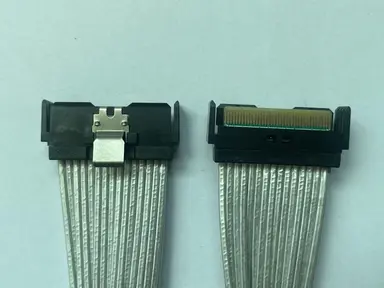

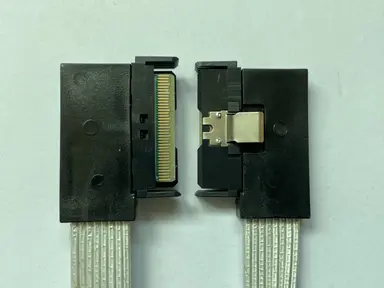
Dongguan Suntecc's MCIO Cable Solutions
Dongguan Suntecc offers a full range of MCIO cable assemblies based on proprietary technology, featuring:
- High-Performance Materials: Utilizes 30 AWG shielded cable, thick-gold-plated terminals, and high-temperature insulation to ensure low insertion loss and long service life under high-frequency signals.
- Customized Designs: Supports MCIO-to-MCIO, MCIO-to-SlimSAS, MCIO-to-EDSFF, and other interface combinations for motherboard-SSD backplane, CPU-GPU, and CPU-CXL memory expansion connections.
- Rigorous Quality Control: Impedance consistency testing, eye diagram analysis, and hot-plug endurance validation ensure compliance with PCI-SIG Rev6.0 standards and system stability.
Application Scenarios: Empowering AI, Data Centers, and HPC
- AI Training Clusters: PCIe Gen5 and MCIO cables provide high-bandwidth interconnects for 10,000-card GPU clusters, reducing data exchange bottlenecks and improving training efficiency.
- Cloud Servers and Storage: Enables high-speed connections between NVMe SSD arrays and CPUs/accelerators for low-latency data access.
- Heterogeneous Computing Architectures: Connects memory expansion devices via CXL protocol, enhancing resource utilization and supporting memory pooling and sharing.
Conclusion: A Strategic Choice for Future Data Ecosystems
The combination of PCIe Gen5 and MCIO technology provides a foundational interconnect solution for next-generation data centers. Through innovative cable design and manufacturing processes, Dongguan Suntecc helps customers address the challenges of high-speed signal transmission, building efficient and reliable computing infrastructure. As the PCIe Gen6 standard evolves, the company will continue to invest in R&D, providing core connectivity components for global digitalization.